
Showing posts with label French film. Show all posts
Showing posts with label French film. Show all posts
Sunday, February 24, 2013


Tuesday, February 19, 2013
Thursday, August 16, 2012
Le Rayon vert (1986)

When you’re single and looking for love, your nights out mean a lot. Conscious of happy couples who met accidentally at parties, in bars, in lineups, you feel pressure to keep putting yourself out there—to acquiesce to fate; or, to put it less mystically, to the unpredictability of life.
Le Rayon vert concerns a young woman named Delphine (Marie Rivière), faced with this problem on a larger scale. She’s a secretary, newly single, planning a vacation with a friend; but the friend backs out. Delphine is agitated, and not just at this sudden change of plans. She knows that if she travels alone, she’ll have no one to distract her from her loneliness, and worse, no excuse to avoid meeting someone new.
Thursday, July 19, 2012
La Bandera (1935)

La Bandera is a great film for impatient people. It hooks you almost as fast as possible. A drunken couple, teetering through the darkened streets of Barcelona, pass a man in a hurry. The girl, joking, tries to dance with him; but he’s in no mood. He exits, and we see blood on her dress. It’s blood from the man’s hands, where they touched her waist. He’s a murderer, and he’s on the run.

That Pierre Gilieth is a murderer is never in doubt. It’s one of the few things about Gilieth (Jean Gabin) that we know for certain. Other things we know: He is a Frenchman alone in Spain; he has no money and no job; no friends and no woman. He can be easy-going, but he moves frighteningly quickly from frustration to rage—drawing his temper up from some place deeply buried, then directing it with brute force upon the source of his problems. His impulse is it to get away; to be left alone.
Tuesday, July 10, 2012
Army of Shadows (1969)

I avoid detailed synopses of films I’ve never seen. About Jean-Pierre Melville’s Army of Shadows I knew only this: it was a war film, about the French Resistance, depicted in images both intense and bleak.
This was still enough for me to build anticipation. I expected something alternately grim and thrilling, about men and women attempting to thwart the efforts of Nazi occupiers and Vichy collaborators without being captured, tortured, and forced to betray their own. And I wasn’t exactly wrong. Army of Shadows is about that. But while it has these elements in common with caper and escape films, on one hand, and more sympathy-driven human dramas on the other, what’s most striking about Army of Shadows is its nihilism. We finish it not with tears in our eyes for the sacrifice these men and women made, but shaking our heads for the contortions of spirit those terrible times forced them to make.
Friday, July 6, 2012
The Rules of the Game (1939)
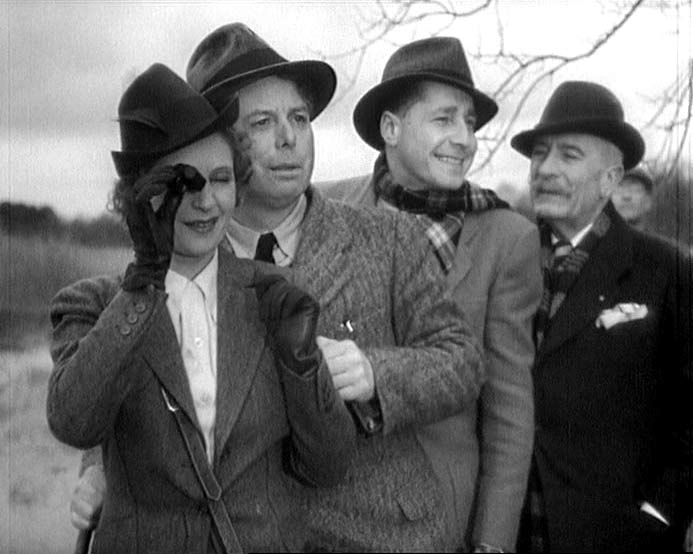
The Rules of the Game is the longest film I’ve ever seen. Not in duration, but in the dimensions of the spaces it depicts. Shot after deep-focus shot shows us figures rushing, fussing, and scurrying thirty feet in the distance—figures who matter just as much as those in the foreground, and who may, at any moment, make an impact just as great. And those tracking shots—director Jean Renoir following his actors as they traverse lengthy hallways in a fabulous mansion, other men and women appearing and disappearing through doorways and around corners all along the way—they’re remarkable.
We get a sense of a place, or time, that could go on forever. And of the immensity of the place itself; and of the puniness, by contrast, of the people who occupy it. The Rules of the Game is a comedy, but a mean one: zeroing in on a collection of men and women too rich, too idle, and too complacent to realize how little meaning their lives have, and suggesting, not so subtly, that the problem doesn’t begin and end with them.
Thursday, June 28, 2012
Excelsior! Prince of Magicians (1901)

Excelsior really was the prince of magicians. His trickery touched the limits of the temporal world. In matters of speed and sleight of hand, a more accomplished artist could not be imagined.
Is this the man we see in Excelsior!: a brief film, only two minutes long; and old—dating to nearly the dawn of the medium? In it, Excelsior delivers his stage show, with an assistant who doubles as his chief prop. The magician is played by Georges Méliès, the French cartoonist, theatre owner and (yes) stage magician, turned filmmaker.
Subscribe to:
Posts (Atom)